

Aero Club of Washington
Home | Join
About Aero Club

News

Why Join

Events

Awards

Education

Board

Aviation Links


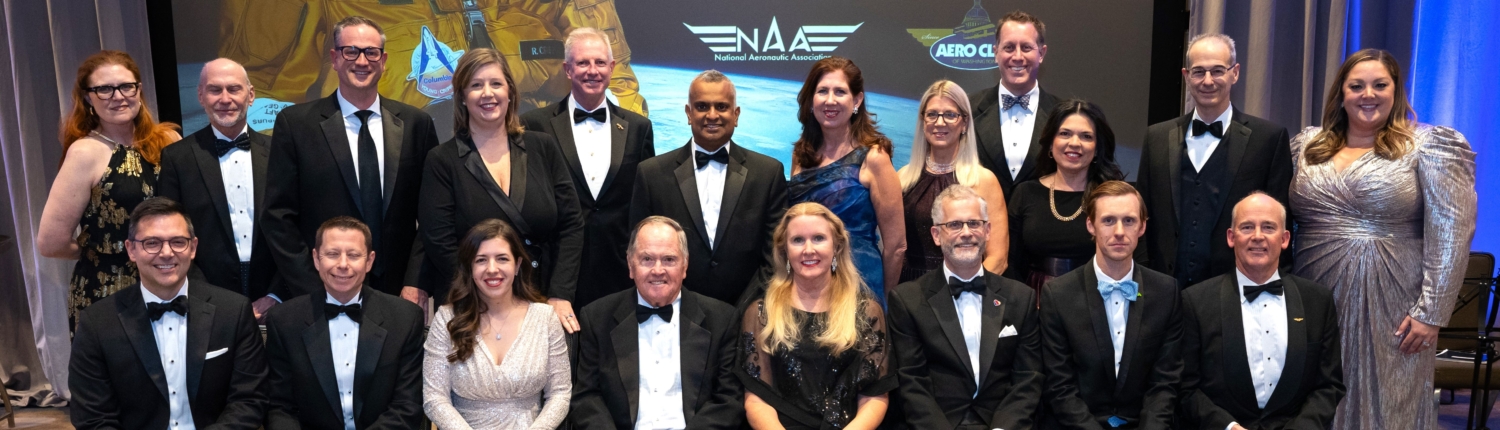
AERO CLUB OF WASHINGTON CENTENNIAL BOARD PICTURE


The Aero Club of Washington Orville and Wilbur Wright

Centurions of Aviation

To commemorate the Centennial of the Aero Club of Washington, the Board has selected a representative individual from each decade since the establishment of the Aero Club in 1909. Those selected represent, in broad relief, the ideals, the membership, the diversity, and the ingenuity that has marked the Aero Club of Washington since its establishment.

During each luncheon this year, we will remember one of these aviation legends and honor those unique achievements that have helped to shape our air and space nation as we know it today.

The Aero Club of Washington honors the brothers who first took a self-propelled, heavier-than-air, controllable aeroplane from the windswept sand dunes of Kitty Hawk into the crisp morning air for the very first time, by naming the Centurion's list after them. For demonstrating ingenuity, determination, courage, patience, and skill that set the standard for those giants who have followed the path to aviation greatness, we hereby proclaim that these ten intrepid individuals—one representing each decade of flight since 1909—shall be known hereafter as The Aero Club of Washington Orville and Wilbur Wright Centurions of Aviation.

_________________________________

JUNE CENTURION

John Herschel Glenn, Jr. (Colonel, USMC, Ret.)

(Astronaut, First to Orbit Earth, 1962)

Marine, Astronaut, Businessman, Politician

View of Mercury-Atlas 6 astronaut John Glenn, in spacesuit and helmet, posed by the "Friendship 7" Mercury capsule; a technician can be seen working in hatchway of the capsule, Cape Canaveral , Florida , January 23, 1962.  

NASA via National Air and Space Museum , Smithsonian Institution (SI 88-6821)

John Glenn entered the Naval Aviation Cadet Program in March 1942 and commissioned in the Marine Corps in 1943. After advanced training, he joined Marine Fighter Squadron 155 and spent a year flying F-4U fighters in the Marshall Islands . During his World War II service, he flew 59 combat missions. During the war in Korea , he flew 63 missions with Marine Fighter Squadron 311. Then, as an exchange pilot with the U.S. Air Force Glenn flew 27 missions in the in F-86 Sabre jet fighter in which he downed three enemy MiG's in combat along the Yalu River .

After Korea , Glenn became a naval test pilot. In July 1957, while project officer of the F8U Crusader, he set a transcontinental speed record from Los Angeles to New York , spanning the country in 3 hours and 23 minutes—the first transcontinental flight to average supersonic speed. Glenn has nearly 9,000 hours of flying time, with approximately 3,000 hours in jet aircraft.

Glenn was assigned to the NASA Space Task Group at Langley Research Center , Hampton , Virginia , in April 1959 after his selection as a Project Mercury Astronaut. The Space Task Group was moved to Houston and became part of the NASA Manned Spacecraft Center in 1962.

On February 20, 1962, Glenn piloted the Mercury-Atlas 6 "Friendship 7" spacecraft on the first manned orbital mission of the United States . Launched from Kennedy Space Center , Florida , he completed a successful three-orbit mission around the earth, reaching a maximum altitude of approximately 162 statute miles and an orbital velocity of approximately 17,500 miles per hour. Mission duration from launch to splashdown was nearly 5 hours.

He was promoted to the rank of Colonel in October 1964 and retired from the Marine Corps on January 1, 1965. He was a business executive from 1965 until his election to the United States Senate in November 1974.

STS-95 Discovery (October 29 to November 7, 1998) was a 9-day mission during which the crew supported a variety of research payloads including deployment of the Spartan solar-observing spacecraft, the Hubble Space Telescope Orbital Systems Test Platform, and investigations on space flight and the aging process. The mission was accomplished in 134 Earth orbits, traveling 3.6 million miles in 213 hours and 44 minutes. Glenn retired from the U.S. Senate in January 1999.

_________________________________

MAY CENTURION

1949-1958

Clarence “Kelly” Johnson

(Aircraft Designer, Lockheed Skunk Works)

Informal portrait of Clarence L. 'Kelly' Johnson standing next to the right wing tip of a Lockheed U-2A (s/n 56-6683, Article 350[?]\ r/n N-803X - later converted to U-2B). National Air and Space Museum , Smithsonian Institution (SI 92-4086). 

Clarence Leonard "Kelly" Johnson (February 27, 1910 – December 21, 1990) was an aircraft engineer and aeronautical innovator. As a member and first team leader of the Lockheed Skunk Works, Johnson worked for more than four decades and is said to have been an “organizing genius.” He played a leading role in the design of over forty aircraft including several that were honored with the prestigious Collier Trophy. Johnson acquired a reputation as one of the most talented and prolific aircraft design engineers in the history of aviation.

While at Lockheed, Johnson designed the P-38 Lightning fighter, made Fowler flaps work on the L-14 Super Electra, and played a major role in converting the type into the Royal Air Force's Lockheed Hudson on short notice in 1938. He worked on the development of the Constellation for Howard Hughes' TWA airline.

Johnson contributed to the design of the following Lockheed aircraft:

Orion 9D, Model 10 Electra/XC-35/C-36/Y1C-37, Model 12 Electra Junior, Model 14 Super Electra, Model 18 Lodestar, Model 22, PV-1 Ventura/B-37, P-38 Lightning, Constellation/Super Constellation, F-80 Shooting Star (the first successful American jet fighter); T-33/TV-2 trainers, P2V Neptune, XF-90, F-94 Starfire , X-7 , F-104 Starfighter, F-117A Nighthawk, C-130 Hercules, U-2, Blackbird family: A-12, YF-12, SR-71, M-21, and D-21; JetStar/C-140, and AH-56 Cheyenne.

Johnson's famed 'down-to-brass-tacks' management style was summed up by his motto:

"Be quick, be quiet, and be on time."


________________________________

APRIL CENTURION

1939-1948

General of the Air Force

Henry H. “Hap” Arnold

Hap Arnold in front of his B-17 “Argonaut” (USAF Image)

Henry "Hap" Arnold was one of our great commanders and directed more than 2.4 million Airmen and 300,000 aircraft during WW II. The only airman to hold five-star rank, he led the Army Air Forces through World War II with a strength, tenacity, and vision that was instrumental to victory, while at the same time breaking his own health.

Graduating from West Point in 1907, Arnold earnestly desired an assignment to the cavalry but instead was posted to the infantry. Despite exciting and formative experiences in the Philippines , he still hankered for the cavalry. Once again he was refused. He then transferred to the Signal Corps, and in 1911 he became one of our first military pilots.

Over the next three decades he became widely recognized as an outstanding aviator (he won the coveted Mackay Trophy twice), commander, and staff officer. When Oscar Westover, chief of the Air Corps, was killed in a plane crash in September 1938, Arnold took his place and led the air arm for the next seven years. But the long hours and incredible pace he set for himself took their toll. He suffered severe heart attacks during the war, and another in 1950 took his life.

A unique aspect of Arnold 's life was a singular appreciation for the integral relationship between science, technology, and airpower. Early in his career Arnold recognized that a second-rate air force was worse than none at all. The path to aviation leadership was a strong research-and-development program and a commitment to progress. Arnold s vision in this regard was extraordinary. He consciously pursued contacts with leading scientists, industrialists, and engineers, planting in them ideas and urging them to move more quickly and boldly. He supported research into cruise and ballistic missiles, precision weapons, jet engines, and rockets. There also existed a special relationship between Arnold and the brilliant aeronautical scientist Theodore von Kármán, who in 1945 wrote the seminal Toward New Horizons , a detailed look at the future of air and space technology that would serve as the blueprint for military research over the next two decades.

Arnold 's holistic approach to airpower was one of his great insights. He understood that it took more than a collection of military airplanes to generate airpower. Needed also were a strong industrial base, robust research and development, a broad aviation infrastructure, a large pool of qualified personnel, and, perhaps most importantly, a clearly devised, coherent, and codified doctrine for the employment of those assets. Arnold , believing unshakably in the importance of strategic airpower, labored to ensure that America possessed all of these necessary factors during WW II.

__________________________

MARCH CENTURION

1929-1938

Daniel Guggenheim

Daniel Guggenheim (1856 – 1930), American industrialist and philanthropist

United States Library of Congress's Prints and Photographs Division under the digital ID ggbain.03559

Often, advances in aviation technology occur through the efforts of private citizens who maintain an interest in aviation and the financial means to bring them about independently. This occurred in the 1920s, when Daniel Guggenheim and his son Harry, two men who are generally not well known outside aviation history circles, contributed significantly to the growth of aviation and aviation technology in the United States . The two acted as catalysts for a number of significant technological advances that the aviation industry widely adopted and that would prove beneficial to everyone who flies today.

The Guggenheims were a wealthy family who made the bulk of their money from the mining industry. They believed they had an obligation to return to society some of the benefits from this very successful business, so in 1924, Daniel, one of 11 children, and his wife Florence established the Daniel and Florence Guggenheim Foundation to promote a variety of charitable and benevolent causes. Daniel never learned to fly but became interested in the airplane for both military and civilian purposes, particularly after his son, Harry, became a pilot during WW I. Between 1925 and 1930; the family invested more than $2.6 million in a series of aviation-related programs.

The Daniel Guggenheim Fund for the Promotion of Aeronautics was formally established on June 16, 1926. Its major goals related to aeronautical education, aeronautical research, the development of commercial aircraft and aircraft equipment, and the application of aircraft to a variety of economic and social activities.

The Guggenheim Fund gave American aviation crucial support during its formative years when individuals could still impact the direction of an entire industry. It supported a wide range of scientific, educational, and social programs relating to aeronautics that stemmed from Daniel and Harry's enthusiasm about aviation and their desire to benefit society.

___________________________

FEBRUARY'S CENTURION

1919-1928

Charles Lindbergh

Charles Augustus Lindbergh and his Ryan NYP "Spirit of St. Louis "

Informal full length pose of Charles A. Lindbergh standing at right wing tip of his Ryan NYP "Spirit of St. Louis" (r/n N-X-211) (right side view of airplane). Propeller spinner not fitted. Probably taken at Roosevelt Field , NY in early May, 1927.

Photographer:   Underwood & Underwood.

On May 21, 1927, Charles A. Lindbergh completed the first solo nonstop transatlantic flight in history, flying his Ryan NYP "Spirit of St. Louis " 5,810 kilometers (3,610 miles) between Roosevelt Field on Long Island , New York , and Paris , France , in 33 hours, 30 minutes. With this flight, Lindbergh won the $25,000 prize offered by New York hotel owner Raymond Orteig to the first aviator to fly an aircraft directly across the Atlantic between New York and Paris . When he landed at Le Bourget Field in Paris , Lindbergh became a world hero who would remain in the public eye for decades. He was awarded a Distinguished Flying Cross and a rare peacetime Special Congressional Medal of Honor for the event; and the citation reads:

For displaying heroic courage and skill as a navigator, at the risk of his life, by his nonstop flight in his airplane, the "Spirit of St. Louis," from New York City to Paris, France, 20-21 May 1927, by which Capt. Lindbergh not only achieved the greatest individual triumph of any American citizen but demonstrated that travel across the ocean by aircraft was possible.

The aftermath of the flight was the "Lindbergh boom" in aviation: aircraft industry stocks rose in value and interest in flying skyrocketed. Lindbergh's subsequent U.S. tour in the "Spirit of St. Louis" demonstrated the potential of the airplane as a safe, reliable mode of transportation. "Spirit of St. Louis" was named in honor of Lindbergh's supporters in St. Louis , Missouri , who paid for the aircraft. "NYP" is an acronym for "New York-Paris," the object of the flight.

______________________________________

JANUARY'S CENTURION

1909-1918

Alexander Graham Bell

Alexander Graham Bell, center, stands facing Frederick Walker "Casey" Baldwin; aircraft partially seen in background may be Aerial Experiment Association (AEA) Aerodrome No 2 White Wing; possibly at Hammondsport , New York , May 1908. National Air and Space Museum , Smithsonian Institution 

Alexander Graham Bell (3 March 1847 – 2 August 1922) was an eminent scientist, inventor and innovator who is widely credited with inventing the first practical telephone. He was an inventor, Aero Club of Washington Founding Member, and Trustee on the First ACW Board of Managers.

Many other inventions marked Bell 's later life including work in aeronautics. In 1888, Alexander Graham Bell became one of the founding members of the National Geographic Society. In 1891, Bell had begun experiments to develop motor-powered heavier-than-air aircraft. The AEA was first formed as Bell shared the vision to fly with his wife, who advised him to seek "young" help as Alexander was already 60 years old.

Bell was a supporter of aerospace engineering research through the Aerial Experiment Association (AEA), officially formed at Baddeck , Nova Scotia , in October 1907 at the suggestion of Mrs. Mabel Bell and with her financial support. The AEA was headed by Bell and the founding members were Glenn H. Curtiss, Lieutenant Thomas Selfridge, Frederick W. Baldwin, and J.A.D. McCurdy.

The AEA's work progressed to heavier-than-air machines, applying their knowledge of kites to gliders. Moving to Hammondsport, the group then designed and built the Red Wing , framed in bamboo and covered in red silk and powered by a small air-cooled engine. On 12 March 1908, over Keuka Lake, the biplane lifted off on the first public flight in North America . The innovations that were incorporated into this design included a cockpit enclosure and tail rudder (later variations on the original design would add ailerons as a means of control). One of the AEA project's inventions, the aileron, is a standard component of aircraft today. (The aileron was also invented independently by Robert Esnault-Pelterie.) The White Wing and June Bug were to follow and by the end of 1908, over 150 flights without mishap had been accomplished. However, the AEA had depleted its initial reserves and only a $10,000 grant from Mrs. Bell allowed it to continue with experiments.

Their final aircraft design, the Silver Dart embodied all of the advancements found in the earlier machines. On 23 February 1909, Bell was present as the Silver Dart flown by J.A.D. McCurdy made the first aircraft flight in Canada . With the successful flight, the AEA disbanded.


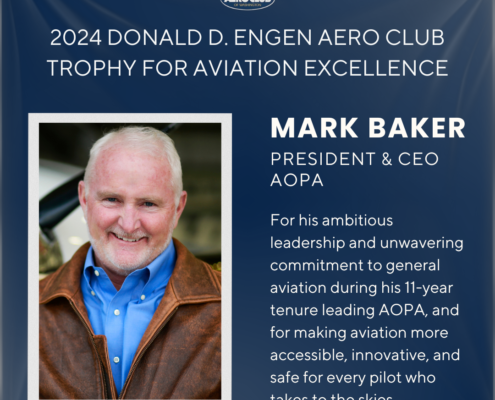
ENGEN TROPHY WINNER

For more information about the Aero Club please write us at: Aeroclub1@verizon.net


Founded in 1909, the Aero Club of Washington is a professional organization of individuals interested in the promotion of aviation and aerospace issues. The Club organizes many networking opportunities throughout the year, sponsors major industry awards and administers educational programs through its Foundation. For more information about our organization and its history, visit the About Aero Club page.

Throughout the year, the Aero Club of Washington hosts many events at which key Washington, DC aviation and aerospace community members gather. The highlight of each year is the Aero Club’s Wright Memorial Dinner, one of American aviation's premiere events, held every December.

The group also holds monthly networking luncheons featuring noteworthy speakers and honors industry leaders with its awards. To learn about upcoming Aero Club events, awards, or past award winners, visit the Events and Awards pages.

The Aero Club Foundation sponsors educational initiatives for students and interns seeking careers in aviation. For details, visit the Education section.

New, current, and former members may join/renew at any time during the year.


Aero Club of Washington
P.O. Box 17295 • Dulles International Airport • Washington, DC 20041 • Aeroclub1@verizon.net
Tel: 1-800-322-3761 and 1-703-327-7082
About Aero Club | News | Why Join | Events
Awards
| Education | Board | Aviation Links